30 Years of

TRADITION AND EXPERIENCES

We print your vision

Specialized
printing company
for packaging and
labels


Tradition


References

Quality

Graphic

Flexibility

Certificates
Aluprint is a well established European supplier of packaging and labels for the beverage, food, dairy and cosmetics industries, while also providing solutions to customers across a wide range of other sectors. Our portfolio includes cut and die cut paper labels, plastic wraparound and sleeve labels, shrink sleeve solutions, as well as practical and modern stand up pouches - doypack.

We have built our strong position in the European market on the basis of many years of experience, modern technologies and continuous innovation. Thanks to our responsible and professional approach, we are trustworthy, reliable and fair partner in the printing industry for our business partners, employees and the public.

 
shrink sleeves
wraparound labels
cut and die cut labels
self-adhesive labels
 
ABOUT ALUPRINT

PRODUCTS


  Blog

PPWR and Packaging: What the New EU Rules Mean for Labels and Packaging Materials

PPWR and Packaging: What the New EU Rules Mean for Labels and Packaging Materials

PPWR introduces new rules that will gradually affect the design, labelling, and recyclability of packaging. Read on to find out why these rules also apply to labels, what will change in the next few years, and how Aluprint is approaching the new requirements.


The new Packaging and Packaging Waste Regulation (PPWR) generally applies across the European Union from 12 August 2026. Its aim is to reduce packaging waste, use materials more efficiently and gradually improve the recyclability of packaging. The new rules affect the entire packaging value chain, including labels and flexible packaging. The label material, adhesive, printing inks and surface finishes can all influence how the packaging as a whole is sorted and recycled. In this article, we briefly explain what PPWR introduces and what should be considered when designing labels and choosing a packaging solution.


What is PPWR?

PPWR stands for the Packaging and Packaging Waste Regulation. Regulation (EU) 2025/40 of the European Parliament and of the Council introduces common packaging rules across the European Union. It applies to all packaging, regardless of the material or industry. This includes plastic, paper, metal, glass and composite packaging. The Regulation covers the entire packaging life cycle. From design and production to use, collection, reuse and recycling.

PPWR focuses primarily on:

  • preventing packaging waste and reducing the amount of material used,

  • improving packaging recyclability,

  • increasing the use of recycled material in selected plastic packaging,

  • restricting certain substances in packaging,

  • introducing more harmonised labelling and supporting reuse.

PPWR does not introduce a blanket ban on plastic packaging, nor does it require every plastic label to be replaced with a paper one. The appropriate solution depends on the specific product, material and design of the entire package. The individual requirements are being introduced gradually, and detailed implementing rules are still being developed in some areas.


Why Does PPWR Also Apply to Labels? 

A label is more than a carrier of branding, design and product information. According to the PPWR, labels hung directly on a product or attached to it may be considered packaging. A label affixed to a bottle, jar or other type of packaging is generally considered part of the complete packaging unit.

When assessing packaging, it is therefore not enough to consider only the material of the main container. It is also important to understand how the label and other components behave during sorting and recycling. The outcome can be influenced in particular by:

  • the material, size and method of application of the label,

  • its compatibility with the main packaging,

  • the adhesive used,

  • printing inks, varnishes and surface finishes,

  • the possibility of the label peeling off during processing.

An unsuitable combination of materials can make the packaging more difficult to identify, sort or recycle. When designing a label, it is therefore important to consider the material of the container, how the packaging will be used and the recycling process for which it is intended. The label and the main packaging should be designed as one functional unit.


What Does PPWR Introduce for Packaging? 

PPWR introduces common packaging rules across the European Union. Its goal is to reduce waste, conserve materials and improve the conditions for the reuse and recycling of packaging. The individual requirements are being introduced gradually, and their specific impact will depends on the material, intended use and type of packaging.

Packaging Recyclability

Packaging will not be considered recyclable simply because its main material can be recycled. The entire packaging unit, including the label, adhesive, closure and other components, will be assessed. From 2030, or later depending on the adoption of detailed rules, recyclability is expected to be assessed according to common Design for Recycling criteria. From 2035, the assessment should also consider whether the relevant type of packaging is collected, sorted and recycled at scale across the EU.


Less Unnecessary Material
From 2030, the weight and volume of packaging must be reduced to the minimum necessary to maintain its functionality. This does not automatically mean using the thinnest material available. The packaging must still protect the product, enable its safe transport, and provide sufficient space for all required information.
 
Restrictions on Certain Substances
The PPWR sets limits for selected substances in packaging and its components. From 12 August 2026, limits on PFAS will also apply to packaging intended to come into contact with food. The complete packaging is considered, including the inks, varnishes, adhesives and other layers used.
 
More Harmonised Labelling 
The PPWR will introduce harmonised labelling of packaging materials to make it easier for consumers to sort packaging correctly. This requirement will apply from 12 August 2028 at the earliest, or later depending on the adoption of implementing rules. A QR code or another digital data carrier may also be relevant for certain types of packaging.
 
Recycled Content in Plastic Packaging 
From 2030, or later depending on the adoption of implementing rules, the PPWR establishes minimum recycled-content requirements for selected plastic packaging. The required proportion will depend on the category and intended use of the packaging and will gradually increase by 2040.


What Does This Mean Specifically for Your Label? 

PPWR does not introduce a single universal “sustainable label” suitable for every product. A solution that works for a glass bottle may not perform equally well on PET or HDPE packaging. A paper label is therefore not automatically better than a plastic one, and using the same material as the container does not in itself guarantee good recyclability.
Material and Construction
When choosing a self-adhesive label, a wraparound label, a shrink sleeve or a die-cut label, it is important to know the material of the container and how the packaging is intended to be sorted and recycled after use. Another key consideration is whether the label should separate during processing or be recycled together with the main packaging.
 
Size and Method of Application
A label can affect the ability of sorting machines to identify the container material correctly. Its size, colour, surface area and method of application all play a role. Wraparound labels and shrink sleeves covering a large proportion of the packaging therefore require particular attention.
Adhesives, Inks and Surface Finishes 
The adhesive, printing inks, varnishes, metallic layers and other finishing effects can also influence the outcome. This does not mean that printing or surface finishes are automatically a problem. However, their suitability must be assessed in relation to the specific combination of materials and the intended recycling process.
 
Before selecting a label, it is therefore advisable to know:
  • the material and colour of the main packaging,
  • the type of product and how it will be used,
  • the countries in which the product will be sold,
  • the required resistance to cold, moisture, grease or chemicals,
  • the method of label application and the desired printing effects,
  • the available technical information on the material used.
The sooner this information is taken into account, the greater the scope for selecting a suitable and practical solution. However, the suitability of the packaging as a whole cannot be determined solely on the basis of the label’s material or its general designation as “recyclable”.


How Is Aluprint Approaching PPWR? 
Compliance with PPWR requirements necessitates cooperation throughout the supply chain. As a label manufacturer, Aluprint supplies one of the components of the final packaging. Compliance cannot therefore be assessed on the basis of the label alone, as it is influenced by the combination of all the components used – for example, the container, the cap, the label, the adhesive and other parts of the packaging.
 
 
Aluprint provides customers with the technical documentation required to assess the final packaging solution. Depending on the specific product, these may include:
  • material specifications and technical data sheets,
  • declarations regarding the substances used,
  • available information on recyclability,
  • declerations provided by material suppliers,
  • other relevant information and supporting documentation.
For products intended to come into direct contact with food, documentation relating to the relevant requirements for food contact materials may be provided separately.
 

The final assessment and declaration of conformity apply to the complete packaging system, not to the label as an isolated component. The responsible entity placing the final packaging or packaged product on the market bases this assessment on information provided by the individual suppliers. Aluprint’s role is to provide reliable data about the label supplied and to support customers in finding a suitable solution.

 
What Will Change in the Coming Years? 
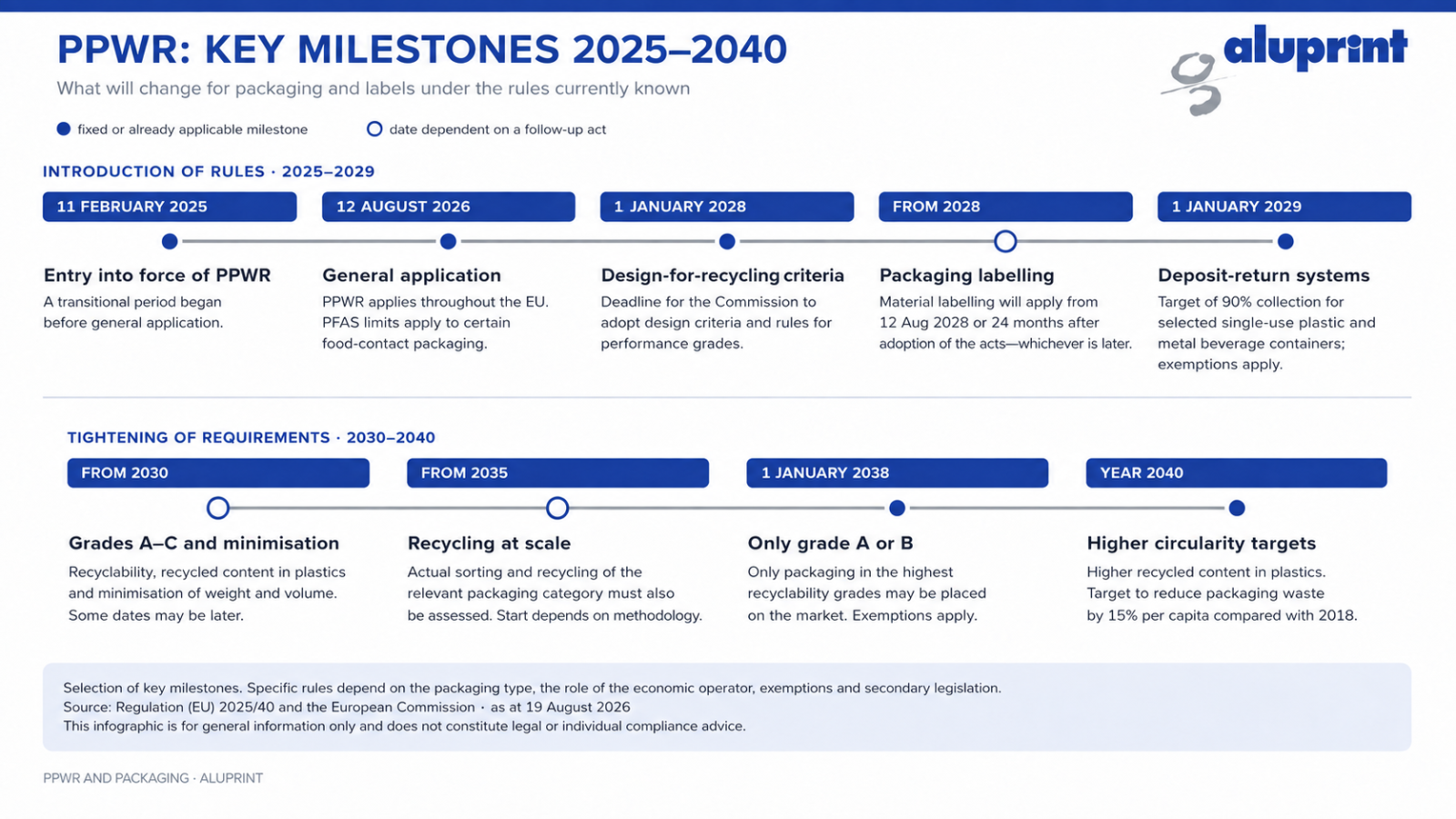
The PPWR requirements will not be introduced all at once. The timeline shows the main milestones, beginning with the Regulation’s general application in 2026 and continuing through new labelling rules, deposit-return systems and packaging design requirements, followed by stricter recyclability and recycled-content targets between 2035 and 2040.

For some obligations, the exact date will depend on the adoption of detailed implementing or delegated acts by the EU. We will therefore update the timeline as the regulatory framework develops.

 

Digital, Offset, and Flexographic Printing: What Are the Differences?

Digital, Offset, and Flexographic Printing: What Are the Differences?

When deciding how to execute a printing project, you have several options. The three main categories we utilize are digital printing, offset printing, and flexographic printing. Each has its specific characteristics, advantages, and disadvantages. Let's find out which one is best suited for your needs.

When deciding how to execute a printing project, you have several options. The three main categories we utilize are digital printing, offset printing, and flexographic printing. Each has its specific characteristics, advantages, and disadvantages. Let's find out which one is best suited for your needs.
 

tlačiareň aluprint​

Digital Printing

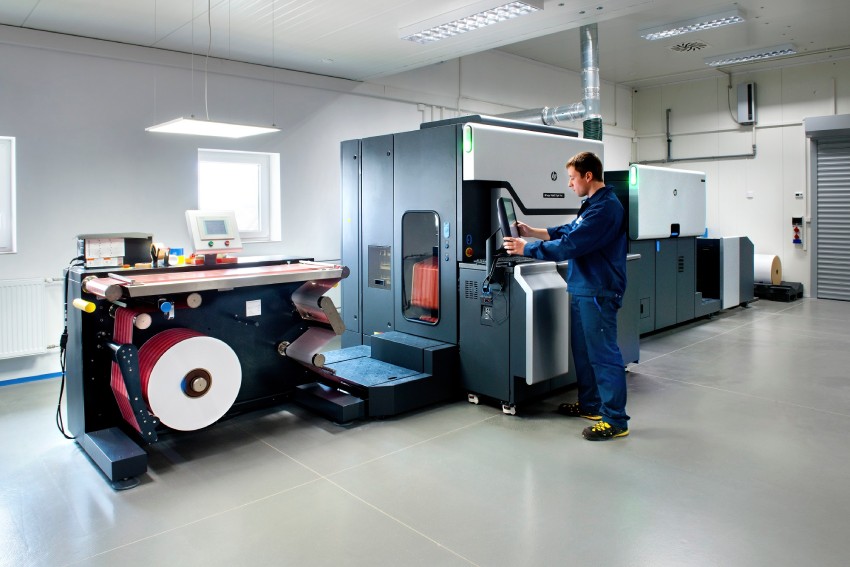
Digital printing allows us to print directly from a computer without the need to prepare printing plates. We use it for small and medium runs when clients require rapid delivery. Its main advantages are:​

  • An excellent choice for projects where speed and flexibility are essential.

  • A wide range of printable materials (paper, metallic, white and transparent films, combined barrier materials for flexible packaging, etc.).

  • Suitable for small series.​

HP Indigo WS6600 Digital Press Takes It Even Further

It offers efficient and high-quality product presentation with perfect image and consistent colors, even for low-volume runs. HP Indigo has everything you need. Its main advantages are:​

  • Frequent design changes are not a problem.

  • Zero costs for design changes.

  • Small and medium orders with a multitude of label variations.

  • Variable print data – serial numbers, EAN and QR codes, graphic elements.

  • No waiting – you get express delivery.​

Offset Printing

Offset printing operates on the principle of transferring an image from a printing plate to the substrate using a rubber-covered transfer cylinder, known as the offset cylinder or blanket. The process step by step is as follows:​

  1. Preparation of the printing plate: The plate is usually a metal sheet with printing and non-printing areas.

  2. Before applying ink, the plate is moistened with a solution of water and additives. This adheres to the non-printing areas, which repel water.

  3. Ink is applied to the plate using ink rollers. The ink adheres only to the printing areas, which are oleophilic, as water on the non-printing areas repels the ink.

  4. The image from the plate is transferred to the offset cylinder (blanket) covered with rubber.

  5. From the offset cylinder, the image is transferred under pressure to the substrate (paper, film, etc.).​

Advantages of Offset Printing

  • Excellent print quality with accurate colors.

  • Ability to use special colors (metallic shades, precise colors according to PANTONE).

  • A suitable solution for high-volume runs (thousands of pieces).​

Preparing printing plates for offset takes some time, but the result is professionally looking printed materials.​

We choose offset for demanding projects – it's intended for clients who require stable label quality even for million-piece runs. Offset is also used for printing catalogs, magazines, books, or representative corporate materials in large volumes, where quality and color fidelity are paramount. However, remember that it's mainly limited to paper and some films.​

Heidelberg Speedmaster Simplifies the Entire Process

The Heidelberg Speedmaster meets all the demands of the current market. Thanks to extensive automation of the printing process, it is cost-effective even for smaller orders. For high-volume runs, its fast and stable production truly shines.​

Flexographic Printing

Flexographic printing is a printing technology that uses flexible photopolymer printing plates. Our brand-new Soma Optima machine is ideal for printing on flexible packaging materials, paper, or laminate from roll to roll. It features the following advantages:​

  • High-quality printing even on thin and flexible materials.

  • A broader spectrum of printable materials (paper, films, laminate).

  • Suitable for large volumes and long runs.

  • Efficient printing, especially for packaging and labels.

  • Ability to print with UV inks for high gloss and durability, as well as with solvent-based and water-based inks.

  • Accurate color reproduction thanks to CNC positioning and an automatic register adjustment system.

  • High production speed.​

Additionally, the Soma Optima is equipped with advanced features – a central cylinder with thermal stabilization, which prevents material wrinkling or stretching, and doctor blade chambers that ensure even ink application. Efficiency and speed are further enhanced by an automatic washing system.​

So, Which One to Choose? We're Happy to Advise

Still unsure which technology to choose? We'd be happy to relieve you of this dilemma. Every project is unique and has its specific requirements. Fill out the contact form, and we'll get back to you to find the best solution.​

Self-adhesive labels: Their production, options, and common design mistakes

Self-adhesive labels: Their production, options, and common design mistakes

How many times have we bought a product in a store just because it had an eye-catching label? Self-adhesive labels can grab a customer's attention and influence their purchase decision. But do you know how these labels are made and what options they offer?

How many times have we bought a product in a store just because it had an eye-catching label? Self-adhesive labels can grab a customer's attention and influence their purchase decision. But do you know how these labels are made and what options they offer?

samolepiace etikety

What are self-adhesive labels?

Self-adhesive labels are a special type of label that differs from traditional ones in their method of application. While traditional labels are affixed to products using glue or other attachment methods (e.g., placed inside packaging), self-adhesive labels have an adhesive layer on the back, making them easy to stick to almost any surface.

Advantages of self-adhesive labels:

  • Easy application – just peel the label off the backing and stick it to the product, no glue required.

  • Flexible shapes – they can be cut into rectangles, circles, ovals, or custom die-cut shapes.

  • Material versatility – a wide range of papers and films, with various surface finishes.

  • Edge-to-edge printing – full-color, borderless print thanks to die-cutting on silicone liners.

  • Durability – high resistance to moisture, chemicals, and abrasion when using plastic materials and lamination.

  • Added features – optional perforations, coupons, variable data (e.g., QR codes, serial numbers), and security features like holograms or tamper-proof materials.

Production process of self-adhesive labels

It all begins with the graphic design. The goal is to create a visually appealing and informative label that grabs attention while meeting technical requirements for print.

The next step is choosing the right material – this affects the print quality, label durability, and its performance under various conditions.

At Aluprint, we use a range of printing technologies to bring label designs to life:

tlač samolepiacich etikiet

Offset printing

  • Ideal for large-volume jobs.

  • Delivers high-quality print results.

  • Machines like the Heidelberg Speedmaster are also efficient for smaller jobs.

UV offset printing

  • A hybrid combining offset and flexographic benefits.

  • Enables double-sided printing and speeds of up to 200m/min.

Flexographic printing

  • Suitable for printing on flexible packaging materials, paper, and laminates.

  • Offers precise print control and consistency.

Digital printing

  • Best for small to medium runs.

  • Allows for personalization and variable data (serial numbers, QR codes, etc.).

  • Enables frequent design changes with no extra plate costs.

???? Need help choosing the right method? Contact us – we’ll advise you.

Common mistakes in label design

Even though label design might seem easy, many common mistakes can compromise the final result.

1. Incorrect material selection

Choosing the wrong material can lead to early wear or functional issues.

  • For moisture exposure (cosmetics, refrigerated items): use plastic films like PP, PE, or PVC or laminated paper.

  • For extreme temperatures (frozen goods, automotive): opt for aluminum or thermostable synthetics.

  • For abrasion (shipping labels, heavy-duty use): choose strong materials with lamination or UV varnish.

2. Wrong dimensions or shape

A poorly sized or shaped label looks unprofessional.

Avoid:

  • Labels too small or large for the product surface.

  • Not considering curves or uneven surfaces.

  • Blocking key package areas (openings, seams, instructions).

  • Mismatched shapes (e.g., oval label on rectangular packaging).

3. Overloaded design

Trying to cram in too much info makes the label chaotic and unreadable.

Avoid this by:

  • Including only essential visuals and text.

  • Leaving sufficient white space.

  • Using a consistent style and 1–2 fonts.

  • Clearly organizing elements by priority.

  • Highlighting key aspects (logo, product name, USP).

4. Inappropriate color selection

If the printed colors differ from your brand or design preview, the product’s impression suffers.

Causes include:

  • Using incorrect colors during file prep.

  • Not accounting for color gamut differences between screen and print.

  • Ignoring how label materials affect color appearance.

  • Not setting correct ICC color profiles.

  • Inconsistent color tones across one label batch.

5. Missing legal requirements

Labels must meet legal standards for product info. Missing mandatory data can lead to fines or product recalls.

Mandatory info often includes:

  • Product name and description

  • Ingredients or material composition

  • Weight or volume

  • Manufacturer or distributor info

  • Expiration or best-before date

  • Health or safety warnings

  • Instructions for use or storage

Creating self-adhesive labels requires experience, technical know-how, and attention to many details. Don’t leave it to chance – trust the experts.

All articles

Implementation of successful projects

Zvyšovanie konkurencieschopnosti 2013
Competitiveness increase 2013

Spoločnosť ALUPRINT, s.r.o. realizovala v r. 2013 projekt s podporou EU "Zvýšenie konkurencie- schopnosti firmy ALUPRINT, s.r.o."

Zvyšovanie konkurencieschopnosti 2011
Competitiveness increase 2011

Spoločnosť ALUPRINT, s.r.o. realizovala v r. 2011 projekt s podporou EU "Zvýšenie konkurencieschopnosti firmy ALUPRINT, s.r.o."

Vzdelávanie zamestnancov 2011
Employee aducation 2011

Tento projekt bol realizovaný vďaka podpore z európskeho sociálneho fondu v rámci Operačného programu "Zamestnanosť a sociálna inklúzia".
Formulár príkladov dobrej praxe