The new Packaging and Packaging Waste Regulation (PPWR) generally applies across the European Union from 12 August 2026. Its aim is to reduce packaging waste, use materials more efficiently and gradually improve the recyclability of packaging. The new rules affect the entire packaging value chain, including labels and flexible packaging. The label material, adhesive, printing inks and surface finishes can all influence how the packaging as a whole is sorted and recycled. In this article, we briefly explain what PPWR introduces and what should be considered when designing labels and choosing a packaging solution.
What is PPWR?
PPWR stands for the Packaging and Packaging Waste Regulation. Regulation (EU) 2025/40 of the European Parliament and of the Council introduces common packaging rules across the European Union. It applies to all packaging, regardless of the material or industry. This includes plastic, paper, metal, glass and composite packaging. The Regulation covers the entire packaging life cycle. From design and production to use, collection, reuse and recycling.
PPWR focuses primarily on:
-
preventing packaging waste and reducing the amount of material used,
-
improving packaging recyclability,
-
increasing the use of recycled material in selected plastic packaging,
-
restricting certain substances in packaging,
-
introducing more harmonised labelling and supporting reuse.
PPWR does not introduce a blanket ban on plastic packaging, nor does it require every plastic label to be replaced with a paper one. The appropriate solution depends on the specific product, material and design of the entire package. The individual requirements are being introduced gradually, and detailed implementing rules are still being developed in some areas.
Why Does PPWR Also Apply to Labels?
A label is more than a carrier of branding, design and product information. According to the PPWR, labels hung directly on a product or attached to it may be considered packaging. A label affixed to a bottle, jar or other type of packaging is generally considered part of the complete packaging unit.
When assessing packaging, it is therefore not enough to consider only the material of the main container. It is also important to understand how the label and other components behave during sorting and recycling. The outcome can be influenced in particular by:
-
the material, size and method of application of the label,
-
its compatibility with the main packaging,
-
the adhesive used,
-
printing inks, varnishes and surface finishes,
-
the possibility of the label peeling off during processing.
An unsuitable combination of materials can make the packaging more difficult to identify, sort or recycle. When designing a label, it is therefore important to consider the material of the container, how the packaging will be used and the recycling process for which it is intended. The label and the main packaging should be designed as one functional unit.
What Does PPWR Introduce for Packaging?
Packaging Recyclability
Packaging will not be considered recyclable simply because its main material can be recycled. The entire packaging unit, including the label, adhesive, closure and other components, will be assessed. From 2030, or later depending on the adoption of detailed rules, recyclability is expected to be assessed according to common Design for Recycling criteria. From 2035, the assessment should also consider whether the relevant type of packaging is collected, sorted and recycled at scale across the EU.
Less Unnecessary Material
From 2030, or later depending on the adoption of implementing rules, the PPWR establishes minimum recycled-content requirements for selected plastic packaging. The required proportion will depend on the category and intended use of the packaging and will gradually increase by 2040.
What Does This Mean Specifically for Your Label?
- the material and colour of the main packaging,
- the type of product and how it will be used,
- the countries in which the product will be sold,
- the required resistance to cold, moisture, grease or chemicals,
- the method of label application and the desired printing effects,
- the available technical information on the material used.
How Is Aluprint Approaching PPWR?
- material specifications and technical data sheets,
- declarations regarding the substances used,
- available information on recyclability,
- declerations provided by material suppliers,
- other relevant information and supporting documentation.
The final assessment and declaration of conformity apply to the complete packaging system, not to the label as an isolated component. The responsible entity placing the final packaging or packaged product on the market bases this assessment on information provided by the individual suppliers. Aluprint’s role is to provide reliable data about the label supplied and to support customers in finding a suitable solution.
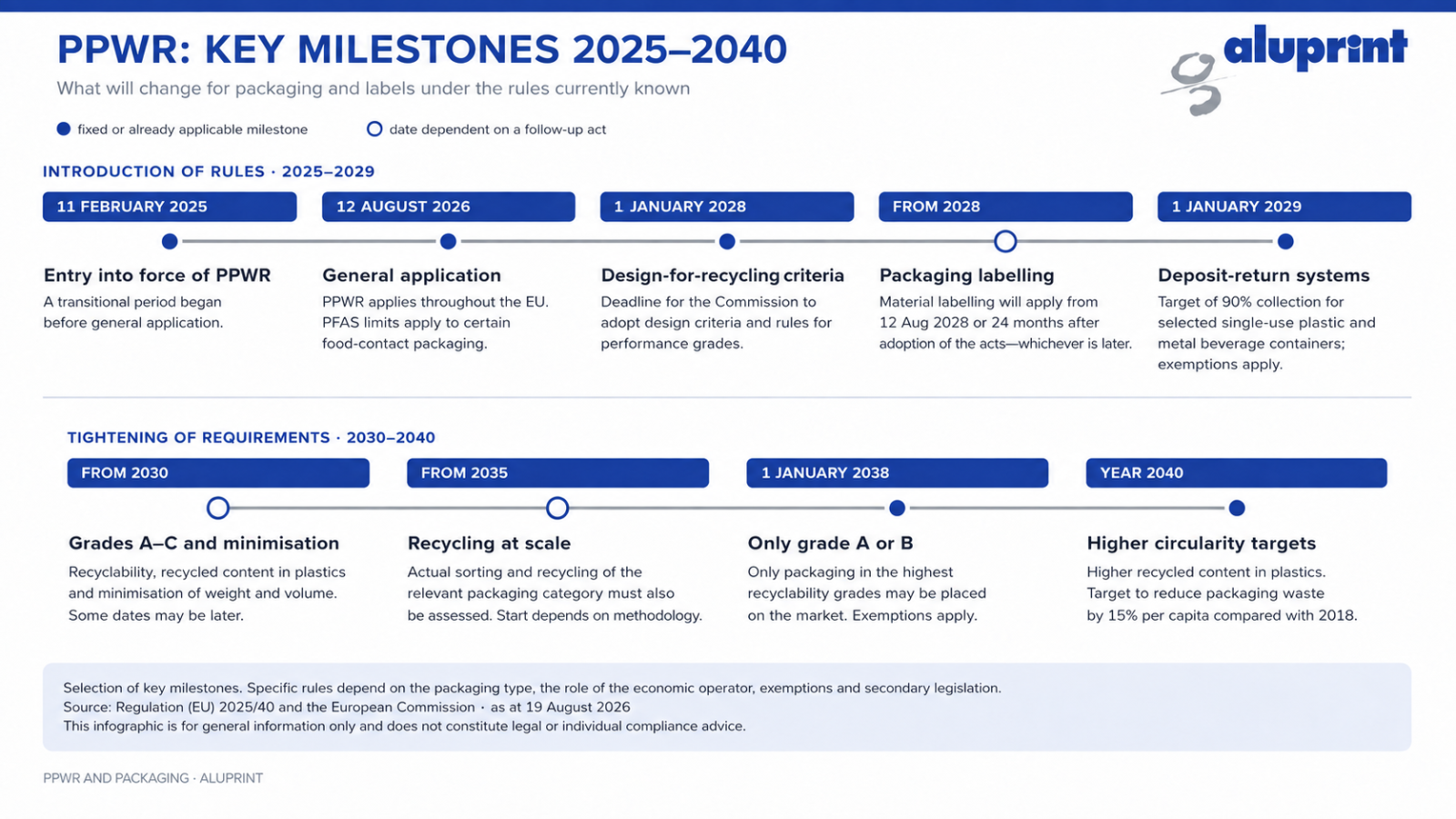
The PPWR requirements will not be introduced all at once. The timeline shows the main milestones, beginning with the Regulation’s general application in 2026 and continuing through new labelling rules, deposit-return systems and packaging design requirements, followed by stricter recyclability and recycled-content targets between 2035 and 2040.
For some obligations, the exact date will depend on the adoption of detailed implementing or delegated acts by the EU. We will therefore update the timeline as the regulatory framework develops.